Before Sleep, My Mentor Wrote an Atlas of the Face
In 1984, a Stanford otolaryngologist did two things that did not appear related at the time. He published a slim volume with Humphreys called Proportions of the Aesthetic Face, a disciplined method for measuring facial balance. And at the Academy meeting in Las Vegas, he gave his first surgical talk on a disease most of medicine did not yet believe could be operated on: obstructive sleep apnea (OSA).
The same man. The same year. The face and the airway, together from the beginning.
His name is Nelson Powell, and he became my mentor.
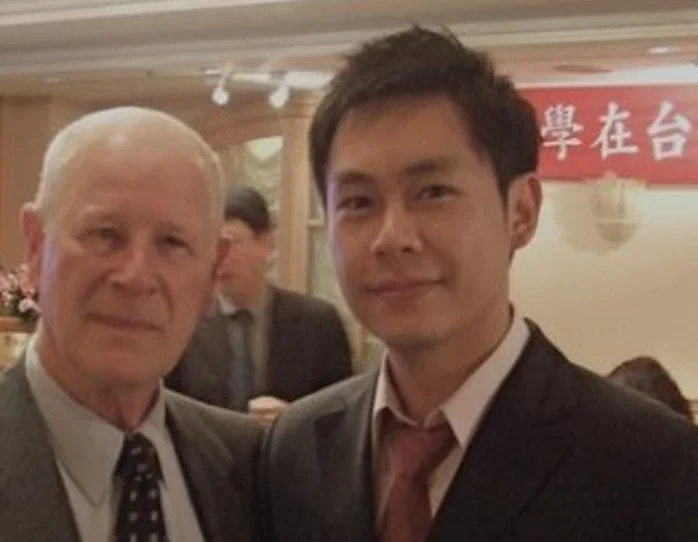
Dr. Nelson Powell, MD, DDS · Stanley Liu as a medical student at UCSF
Dr. Powell traveled the world teaching sleep surgery. I was studying for the USMLE boards in Taiwan when he visited.
An Unlikely Surgeon
Nelson came from an economically depressed town in the North S.F. Bay that he is not fond of. He had a contentious youth and even spent time as a prizefighter. He recounts that when he started college, he could not write a full essay. Two years of community college later, he was admitted to dental school at UCSF, where he graduated in 1974 with seven awards.
He built a profitable dental practice near Davis, California. When he volunteered to take face trauma call at the local hospital, the Chief of Staff told him, “You can go to our wards and teach patients tooth brushing.” Nelson’s reaction to that comment would change the history of sleep surgery.
Nelson sold his practice at the next chance he could, earned his medical degree from the University of Washington, and in 1979 started as an Otolaryngology intern at Stanford. There he reunited with Dr. Robert “Bob” Riley, a fellow UCSF dental graduate who had taken his own road through medicine. Bob finished a four-year residency in oral surgery and completed medical school at the University of Alabama Birmingham before arriving at Stanford Otolaryngology. Neither knew the other would be there.
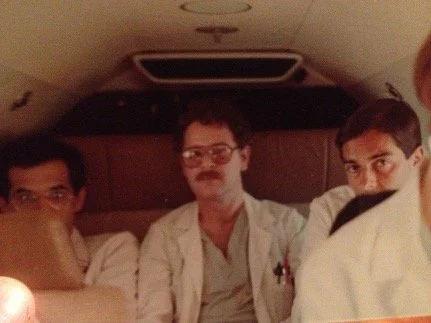
Dr. Nelson Powell, MD, DDS onboard a flight for organ procurement
As an intern, Nelson had impressed Dr. Shumway, the surgeon behind the first successful heart transplant in the United States. Years later, that early respect paid a dividend: Nelson's MMA patients were admitted to the cardiac ICU after surgery, in the best of postoperative hands.
MMA Surgery Began with a Staircase Conversation
A single staircase separated the old ENT clinic from the sleep laboratory of Dr. Christian Guilleminault, “C.G.”, the French neurologist who started sleep medicine as a clinical discipline. C.G. would stop Nelson in the stairwell, holding up cephalometric films of patients whose airways were failing. When C.G. asked whether the maxilla and mandible could both be advanced to open the airway, Nelson gave an answer I think about often: “Give us ten months and we will do it.”
He and Bob spent those months learning orthognathic surgery from Dr. Bill Ware, who had stepped down as Chair of Oral and Maxillofacial Surgery from UCSF, and was operating out of Davies Medical Center in San Francisco.
True to their word, Powell and Riley soon performed the first maxillomandibular advancement (MMA) for sleep apnea on a patient who had failed every other operation. Surgical success for OSA built quickly. The Riley-Powell protocol that grew from that operation carried the “Stanford Sleep Surgery” name around the world.
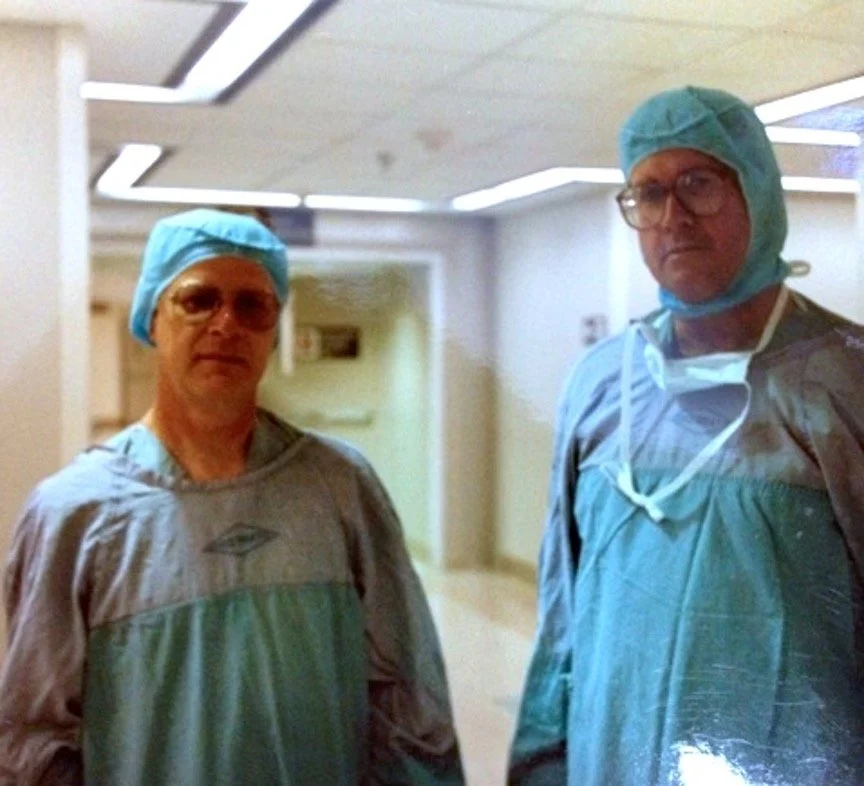
Nelson Powell, MD,DDS · Robert “Bob” Riley, MD, DDS
For decades, the Riley-Powell Stanford Sleep Surgery Protocol, and their MMA surgery, were carried out in Room 12 of the Stanford Main O.R.
What Dr. Riley & Dr. Powell Taught Me
I met Dr. Powell in 2006, after my HHMI year at the NIH. Through long conversations over those years, he showed me what I now consider the central truth of my field: bite, breathing, and beauty are one system. You cannot address one without affecting the others.
I wanted to join Dr. Powell and Dr. Riley in their practice as an apprentice, and in fact, was accepted to be one. Of note, while they operated at Stanford hospital, they were in private practice. Months before I would start, however, Dr. Powell directed me instead toward the sleep surgery fellowship at Stanford. I later learned that he had begun stepping back from operating. He reassured me: “Bob (Dr. Riley) will still be there.”
I completed the sleep surgery fellowship in 2014, spending half of my time with Dr. Robert Riley and the other half with Stanford Otolaryngology, learning the full scope of sleep surgery. Dr. Robert Jackler (Chair) provided valuable resources to grow sleep surgery within the university, as did Dr. Richard Goode, who had trained Nelson and Bob decades earlier.
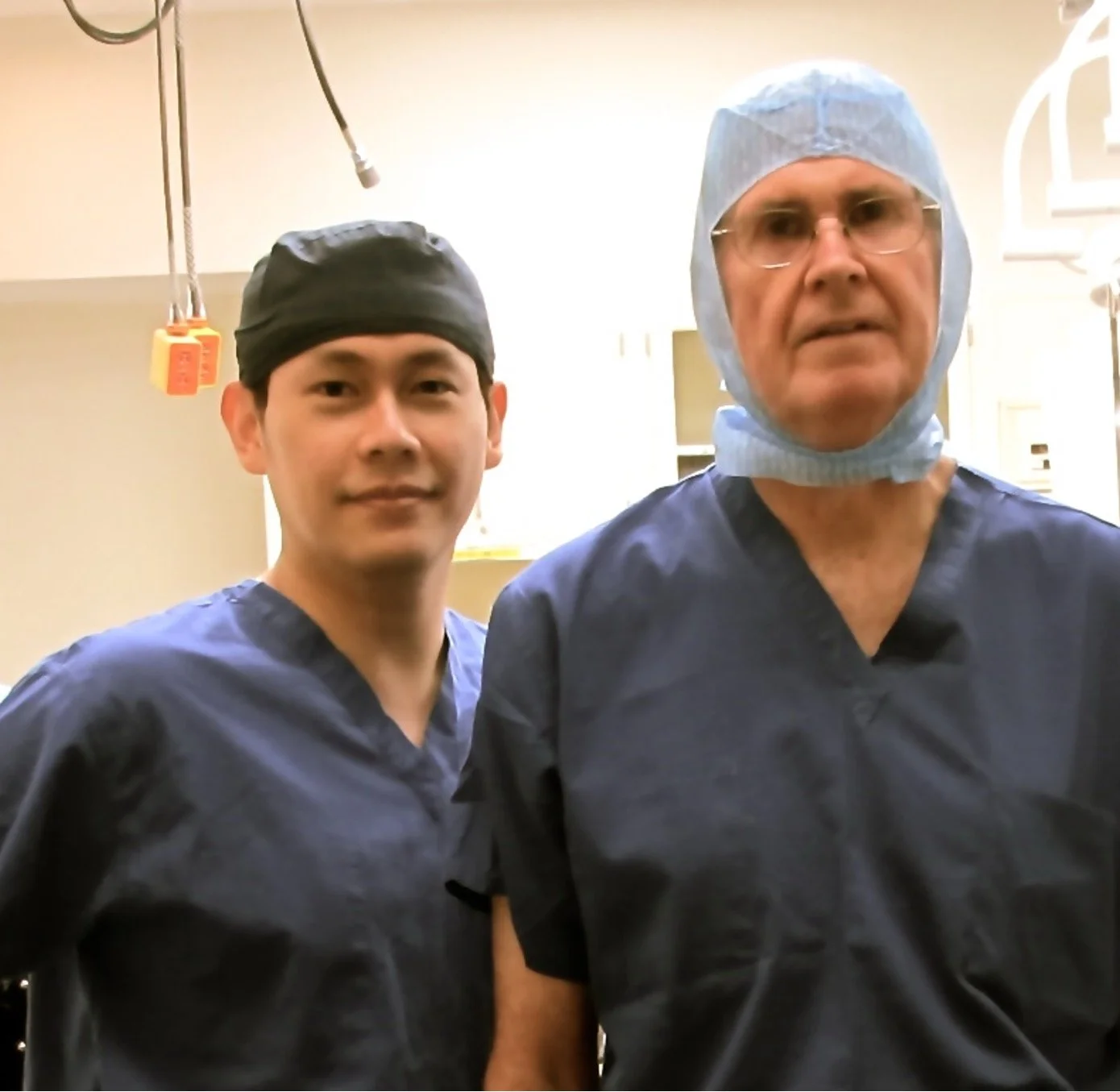
Dr. Stanley Liu, MD, DDS · Dr. Robert Riley, MD, DDS
Bob is left-handed, and both Nelson and I were right-handed. When I became Bob’s “right” hand man for MMA surgery, the unique Riley-Powell flow was a smooth transition. Main OR 12 at Stanford, 2014.
During the fellowship year, I also learned from Dr. Stephen Schendel, another dual degree DDS and MD who had been Chair of Stanford’s Division of Plastic Surgery.
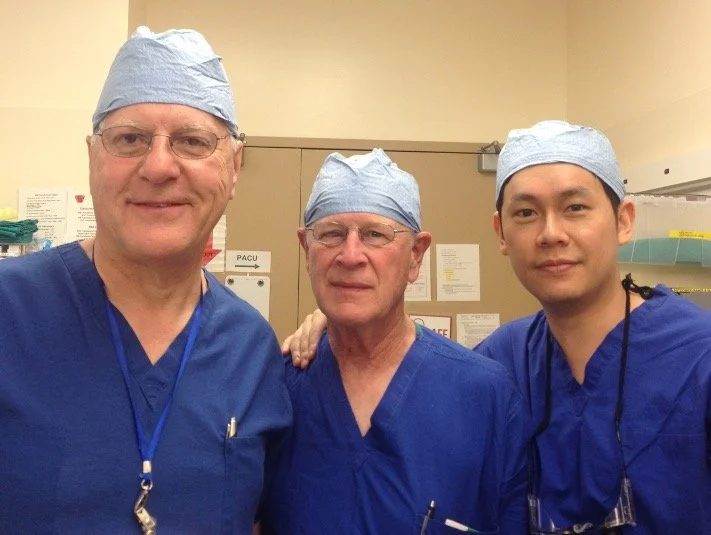
Dr. Stephen Schedel, MD, DDS · Dr. Nelson Powell, MD, DDS · Dr. Stanley Liu, MD, DDS
Early part of my fellowship year in 2013, standing on the shoulder of giants of “Bite, Breathing, Beauty” at the Stanford ASC operating rooms.
If one wanted to learn “bite, breathing, and beauty” from its leading figures, there was exactly one seat in the world: the sleep surgery fellowship at Stanford from 2013 to 2014. I was that fellow.
When we updated the surgical algorithm that guides the OSA field in the subsequent years, it became Riley, Powell, and Liu. This is by far the best way for me to connect with two mentors whom I admire.
The Atlas, Again
Which brings me back to 1984. Proportions of the Aesthetic Face went out of print decades ago, but it never left my shelf. Its premise holds up better today than when it was written: an individual structure acquires clinical meaning only through its relationship to the whole face. Nelson measured the face not to chase beauty for its own sake, but because balance of form is the visible record of function.
Dr. Schendel told me he considers the atlas the best he has seen for its purpose. From a surgeon of his stature, that is not a casual compliment.
Forty years later, we know what Nelson sensed in that same year he first spoke about sleep apnea. The face that is balanced is the face that breathes. The narrow maxilla, the retruded mandible, the long face are not cosmetic footnotes. They are the architecture of the airway, written where anyone trained can see it. The link between beauty and breathing was simply not explicit in the original atlas.
Nelson passed away on the morning of December 10, 2021. His atlas remains out of print. I reached out to the publishers, who were not interested to re-publish it
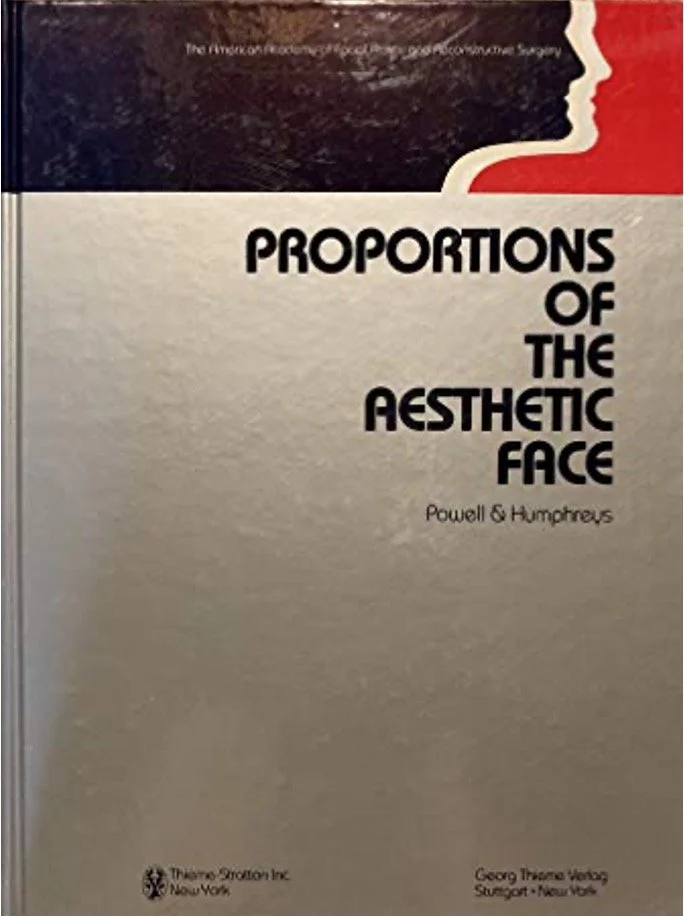
Proportions of the Aesthetic Face
So I am returning to it. Not to rewrite it. My intention is to summarize and teach its most salient points, chapter by chapter, the way Dr. Powell intended.
I will re-introduce this atlas into an app for any clinician to use. With Dr. Powell’s framework as the foundation, the teaching will extend where his career quietly pointed: across the aesthetic face and the healthy airway. One patient, one face, one clinical system.
Innovation by integration.
Stanley Yung-Chuan Liu, MD, DDS, FACS
In memory of Nelson B. Powell, MD, DDS.
Frequently Asked Questions
Who is Dr. Nelson Powell?
Dr. Nelson B. Powell, MD, DDS (died December 10, 2021), was a Stanford otolaryngologist and dual-degree dentist and physician who, with Dr. Robert Riley, founded the field of surgical treatment for obstructive sleep apnea. Together they developed maxillomandibular advancement for sleep apnea and the Riley-Powell Stanford Protocol, and Powell co-authored the 1984 atlas Proportions of the Aesthetic Face.
What is Proportions of the Aesthetic Face?
Proportions of the Aesthetic Face, published by Powell and Humphreys in 1984, is a systematic atlas for measuring facial balance using practical, anatomy-based measurements of the forehead, nose, lips, chin, and neck. Long out of print, it remains a foundational method for clinical facial analysis; craniofacial surgeon Dr. Stephen Schendel has called it the best of its kind for its purpose.
What is the Riley-Powell-Liu sleep surgery algorithm?
The Updated Stanford Sleep Surgery Algorithm, published in 2020 by Dr. Stanley Liu with Dr. Robert Riley, is the contemporary framework guiding surgical treatment of obstructive sleep apnea. It integrates drug-induced sleep endoscopy, patient preference, and multimodal therapy across phased treatment, extending the original Riley-Powell Stanford Protocol into precision medicine.
Where this leads
Dr. Powell taught that bite, breathing, and beauty are one system. These pages are that idea in practice.
Patients considering an evaluation, and colleagues with a case to discuss, can reach Dr. Liu through the contact page.


