What is Inspire Hypoglossal Nerve Stimulation?
Hypoglossal nerve stimulation, also called upper airway stimulation, treats obstructive sleep apnea with a small implanted device. During sleep it gently stimulates the nerve that moves the tongue, so the tongue moves forward and holds the airway open with each breath. Inspire is the system most patients know.
It is an option for adults with moderate to severe sleep apnea who have not been able to use CPAP. Think of it as a pacemaker for the tongue: you turn it on with a remote at bedtime, and it works quietly with your breathing through the night. There is no mask and no hose.
Before surgery
- A recent sleep study and a sleep endoscopy (DISE), which shows where and how your airway closes.
- Stop aspirin, ibuprofen (Advil, Motrin), naproxen (Aleve), fish oil, vitamin E and other supplements that thin the blood 7 days before surgery.
- If a doctor prescribed a blood thinner, do not stop it on your own. We will coordinate with that doctor.
- The operation is done under general anesthesia. Plan for an adult to drive you home.
After surgery
- Most patients go home the same day.
- Keep the small incisions clean and dry. Avoid heavy lifting and strenuous exercise until we tell you the incisions have healed.
- The device is turned on about a month after surgery, once you have healed.
- You use it every night while the strength is adjusted for comfort. A sleep study a few months later fine-tunes the settings.
Call us right away if
- Bleeding or swelling at an incision keeps growing.
- You have a fever above 101°F (38.3°C), or an incision turns red or drains pus.
For an emergency, or any trouble breathing, call 911.
Inspire is placed in an outpatient operation through small incisions in the neck and upper chest. Serious problems are uncommon: in an international registry of more than 1,800 patients, serious adverse events were reported in 2.3% and device revision in 1.9%. We review your own risks with you before surgery.
- Discomfort with stimulation
- Common in the first weeks while you get used to the feeling. Settings are adjusted until it is comfortable, which also helps nightly use.
- Tongue soreness
- The tongue can rub against the lower teeth as it moves forward. This usually settles, and a smooth dental guard can help.
- Temporary tongue weakness
- Can occur after surgery and usually recovers within weeks.
- Swelling, bruising or bleeding
- At the incisions, and usually minor.
- Infection
- Uncommon. Rarely, an infected device must be removed.
- Device or lead problems
- Occasionally the lead or the generator needs to be repositioned or replaced.
- Battery replacement
- The generator battery lasts for years. In the first patients it was replaced after about 8 years, in a shorter procedure.
- MRI scans
- Possible under specific conditions. Tell any imaging team that you have Inspire.
- Anesthesia
- Risks of general anesthesia are reviewed with you by the anesthesia team.
Inspire for patients
Inspire treats the tongue, one of the most common places the airway closes during sleep. A small generator sits under the skin of the upper chest, with a thin lead to the hypoglossal nerve under the jaw. In Inspire V, the newest system, the breathing sensor is built into the generator, so there is no separate sensing lead and the operation is simpler.
Inspire is considered when CPAP has not worked, for adults with moderate to severe sleep apnea whose weight is within the approved range. A sleep endoscopy (DISE) comes first. If the soft palate closes in a full circle, like a drawstring bag pulled shut, moving the tongue forward will not open it. In that case, surgery on the palate or the jaws can change the pattern first, and many of those patients go on to Inspire.
Inspire is one option among several. Within the updated Stanford Sleep Surgery Algorithm, it treats the tongue, while jaw surgery treats the bony framework the airway hangs from. The two can work together.
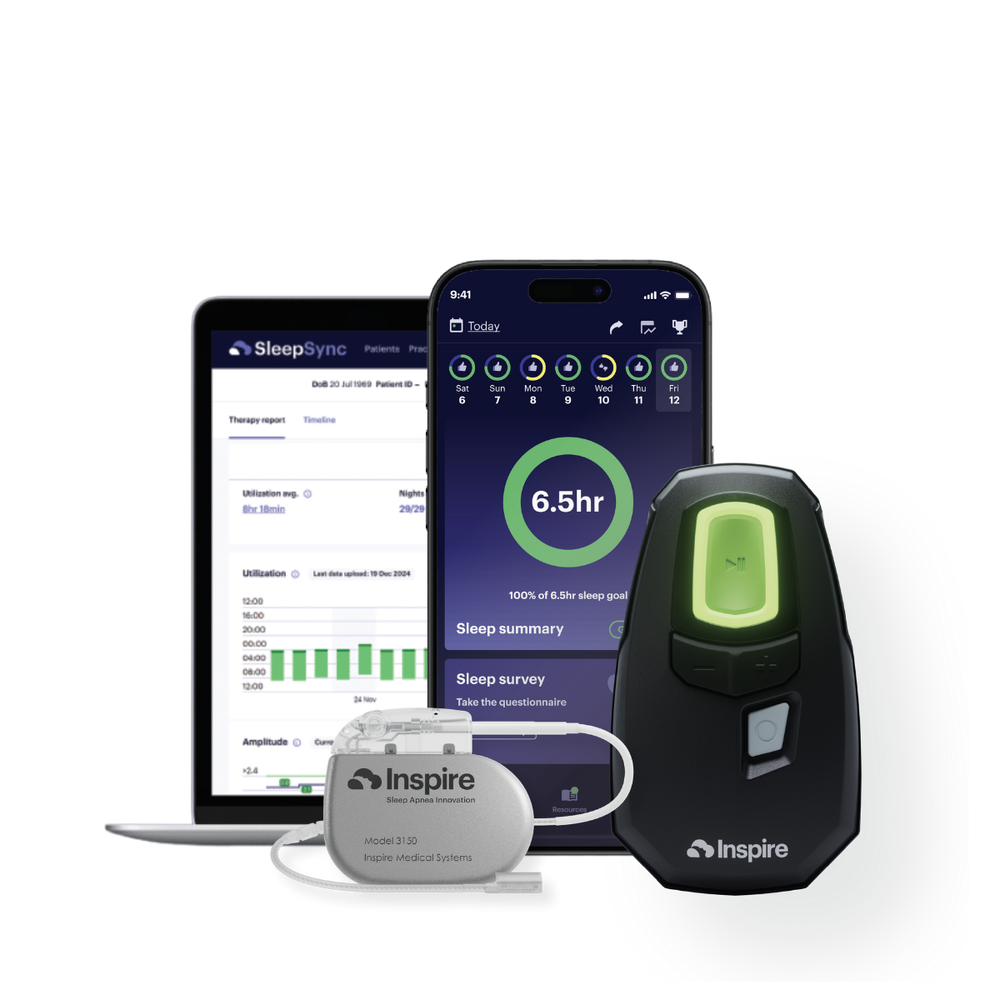
Inspire therapy in action
What stimulation does to the tongue
- 1Protrusion and stiffening of the tongue
- 2Tongue base protrusion, seen under drug-induced sleep endoscopy
Expanding candidacy and optimizing outcome
Dr. Liu's talk on who can benefit from Inspire therapy and how to get the most from it, from SEC 2026.
Inspire for referring physicians
Hypoglossal nerve stimulation recruits the protrusor branches of the hypoglossal nerve, so the tongue advances and stiffens with inspiration. The step that decides the result in the operating room is finding the functional breakpoint between the protrusor and retractor branches, so that the cuff captures the muscles that pull the tongue forward and excludes the ones that pull it back.
Selection follows the updated Stanford protocol: CPAP failure or intolerance, AHI 15 to 65, central apneas under 25%, BMI 32 or below (up to 35 selectively), and no complete concentric collapse of the velum on DISE. The FDA label was widened in June 2023 to an AHI of 15 to 100 and a recommended BMI of up to 40.
Concentric collapse is a disqualifier, not a verdict. A tissue-preserving palatopharyngoplasty converted 12 of 12 such patients to an anteroposterior pattern or no velar collapse, and expansion (DOME) or MMA can convert as well. In Dr. Liu's series, patients who were first ineligible (AHI above 65, BMI above 32 or concentric collapse) and had multilevel surgery before implantation did better than those who qualified from the start, by 18 AHI events per hour after adjustment.
MMA and stimulation treat different parts of the problem. After MMA, relapse is almost always at the tongue base, the target of stimulation, which makes prior MMA patients strong candidates. In one patient, the AHI fell from 145 to 28 after MMA and to 3.2 after stimulation. When stimulation is not tolerated, look for an anatomic cause: in a case report Dr. Liu co-authored, laser reduction of an enlarged lingual tonsil brought the effective setting down to 1.1 to 1.2 V in a patient who could not tolerate more than 2 V.
Dr. Liu's chapters on Inspire therapy
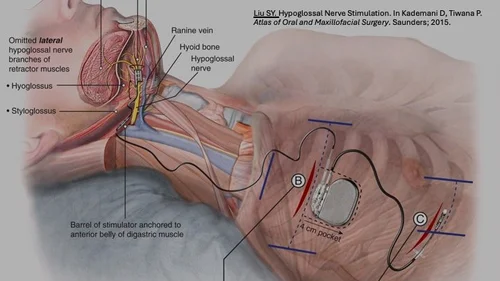
Upper Airway (Hypoglossal Nerve) Stimulation for Treatment of Obstructive Sleep Apnea
An operative manual built around one step: telling apart the nerve branches that push the tongue forward from the ones that pull it back.
Considerations of Facial Skeletal Morphology to Optimize Upper Airway Stimulation
Sleep apnea can have a skeletal cause and a neuromuscular cause. MMA and stimulation treat each in turn, as in the patient whose AHI went from 145 to 28 to 3.2.
Related Research by Dr. Liu
Surgery first can make Inspire possible
Eighteen patients who first did not qualify for Inspire, because their apnea was too severe, their BMI too high or their palate closed in a full circle, had surgery first: palate surgery, DOME or MMA. After Inspire, their AHI fell by 37.6 events per hour on average, against 31.5 in 17 patients who qualified from the start. Adjusted for age, BMI and sex, the staged group did better by 18 events per hour.
Palate surgery opens the door to Inspire
When the soft palate closes in a full circle on sleep endoscopy, Inspire is ruled out. In 12 such patients, a tissue-preserving palatopharyngoplasty changed the pattern in all 12: 9 to front-to-back collapse and 3 to no palate collapse at all. The AHI fell from 54.0 to 33.1 before any implant.
Inspire after jaw surgery
A patient treated with the Stanford phase 1 and 2 operations, including MMA, returned more than a decade later at 65 with moderate sleep apnea. After a sleep study and sleep endoscopy, Inspire cured it. Relapse after jaw surgery tends to occur at the tongue base, which is what stimulation treats.
When jaw surgery is declined
A 65-year-old man with severe sleep apnea (AHI 82.7) and a jaw deformity chose Inspire over jaw surgery. Palate surgery first converted his full-circle collapse. After Inspire his AHI fell to 2, and his lowest oxygen level rose from 75% to 83%.