What is Inferior Turbinate Reduction?
The inferior turbinates are ridges of bone covered by soft tissue along the side walls of the nose. They warm, moisten and filter each breath. When they stay swollen, they block airflow through one or both sides of the nose.
The turbinates swell and shrink on their own through the day and night, usually one side at a time. You may know this feeling: one nostril blocks up when you lie on your side, then the other side takes over when you turn. When both turbinates stay enlarged, there is no open side left. The body then works harder to pull air through the nose during sleep, which can lead to mouth breathing, snoring and sleep apnea.
Turbinate reduction for patients
Turbinate reduction is usually considered when nasal sprays and allergy treatment have not opened the nose enough. The procedure shrinks the swollen tissue inside each turbinate and moves the turbinate toward the side wall of the nose, so more air can pass. The goal is a smaller turbinate, not a missing one. A turbinate that is cut out can leave the nose dry, and some people then feel more blocked than before.
The surgery is done through the nostrils, with no cuts on the face. It is often combined with septoplasty. For patients whose narrow palate also narrows the floor of the nose, maxillary expansion (DOME) may be discussed.
Nasal surgery by itself rarely cures sleep apnea. It eases breathing through the nose and daytime sleepiness, and it helps CPAP or an oral appliance work better.
Before surgery
- Stop aspirin, ibuprofen (Advil, Motrin), naproxen (Aleve), fish oil, vitamin E and other supplements that thin the blood 7 days before surgery.
- If a doctor prescribed a blood thinner, do not stop it on your own. We will coordinate with that doctor.
- Follow the fasting instructions from the anesthesia team.
- Most patients go home the same day. Arrange for an adult to drive you home and stay with you the first night.
After surgery
- The nose often feels more stuffy for the first one to two weeks while the swelling settles. Breathing then improves.
- Light bloody drainage is normal for the first few days.
- Use saline spray or rinses several times a day. Crusts inside the nose are expected and clear over the first few weeks.
- Sleep with your head raised on two or three pillows for the first several nights.
- Do not blow your nose for one week. If you need to sneeze, sneeze with your mouth open.
- Avoid heavy lifting, bending over and hard exercise for one to two weeks.
- If you use CPAP, ask us before you restart it.
Call us right away if
- Bleeding does not slow after 15 minutes of gentle pressure. Lean forward and pinch the soft part of the nose.
- You have a fever above 101°F (38.3°C).
- Pain or swelling keeps getting worse instead of better.
For an emergency, call 911.
Turbinate reduction is a common and well tolerated operation. As with any surgery, there are risks. We review them with you before surgery, since your own risks depend on your anatomy and health.
- Bleeding
- A nosebleed after surgery is usually minor. Rarely, heavier bleeding needs packing or a return to the operating room.
- Crusting
- Common in the first weeks. Saline spray and rinses help it clear.
- Infection
- Uncommon, and treated with antibiotics when it happens.
- Blockage that persists or returns
- Turbinate tissue can swell again over time, especially with allergies. A deviated septum or a narrow nasal floor can also keep the nose blocked, and may need their own treatment.
- Dryness
- The nose may feel dry while it heals. The lining of the turbinate is preserved to protect moisture.
- Scar bands
- Bands of scar can form inside the nose and can be released if they block airflow.
- Empty nose syndrome
- A feeling of blockage despite an open nose. Very rare when the turbinate is reduced rather than removed.
- Anesthesia
- Risks of general anesthesia are reviewed with you by the anesthesia team.
Turbinate reduction for referring physicians
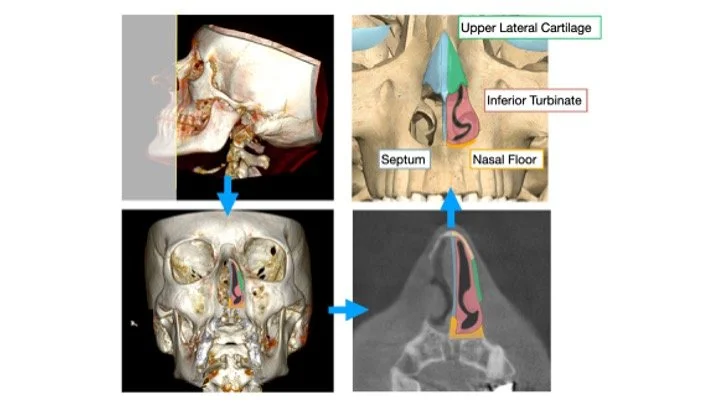
The head of the inferior turbinate forms the posterior boundary of the internal nasal valve (INV), with the septum medially, the caudal edge of the upper lateral cartilage laterally and the bony nasal floor inferiorly. The INV can account for up to 50% of total upper airway resistance. Turbinate hypertrophy is its most dynamic component, changing with the nasal cycle, body position and allergy.
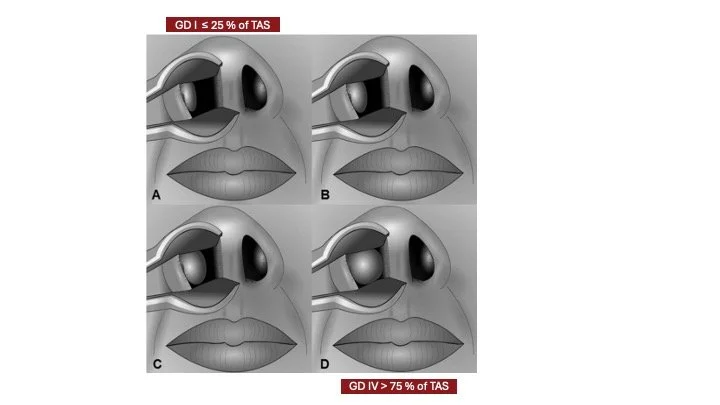
In Dr. Liu's practice, inferior turbinate reduction is performed with radiofrequency ablation and outfracture. The mucosa is preserved and the turbinate is never resected, to protect humidification and avoid empty nose syndrome. Turbinate size is graded on the validated 25% quartile scale (grades 1 to 4), and every evaluation includes nasal endoscopy, since posterior obstruction is missed on anterior rhinoscopy.
Turbinate reduction is often paired with septoplasty and, when indicated, nasal valve repair. It is also one part of the nasal protocol for large maxillomandibular advancement that lowered corrective nasal surgery after MMA from 18.7% to 6.5%. For transverse maxillary hypoplasia with a narrow nasal floor, DOME widens the INV at its skeletal foundation, which soft tissue surgery cannot do.
Nasal surgery is an adjunct in sleep apnea care. It improves sleepiness and positive airway pressure tolerance more reliably than it lowers the AHI. Supine nasal resistance also predicts the CPAP pressure a patient needs. For these reasons the nose is addressed early within the updated Stanford Sleep Surgery Algorithm, alongside palatal, tongue base, neurostimulation and skeletal procedures chosen by phenotype.
Related Research by Dr. Liu
Nasal surgery helps sleep apnea treatment work better
Across 19 studies and 896 patients, nasal surgery alone reduced daytime sleepiness in people with sleep apnea, though it did not significantly lower the apnea hypopnea index. A later review found that nasal surgery lowers the CPAP pressure patients need and helps them keep using it. The nose is treated as the gateway to the rest of sleep apnea care.
The two sides of the nose take turns at night
With a split nasal sensor added to routine sleep studies, the Stanford team saw the nasal cycle in 89% of 28 patients. Each side stayed dominant for about 2.5 hours on average. Switches often came with a change in body position (62%) or the start of dream sleep (41%). This swelling of the turbinates is why one side of the nose can feel blocked when lying down.
A blocked nose lying down raises the CPAP pressure you need
In 43 patients with sleep apnea, nasal resistance measured lying down, together with body mass index, predicted the CPAP pressure each patient needed. The same measurement taken sitting up did not. Opening the nose can make CPAP easier to use.
Turbinate surgery is safe in children
A review of 13 studies and 1,111 children found a complication rate of 3.12%, mostly minor bleeding, and a major complication rate of 0.05%. All studies that measured breathing found improvement. Radiofrequency, coblation, microdebrider and laser techniques appeared safest.