Sleep apnea treatment
Treatment that follows the Revised Stanford Protocol
Dr. Liu treats sleep apnea with the Revised Stanford Sleep Surgery Protocol. His mentors, Dr. Robert Riley and Dr. Nelson Powell, developed the original. Dr. Liu revised it for today's care.
Read the researchOriginal protocol, 1993Revised protocol, 2019Algorithm update, 2020
Evaluate
Find where and how your airway narrows during sleep.
Phase I
Targeted surgery at the nose, soft palate, or tongue.
Phase II
Whole-airway surgery, jaw advancement (MMA), when needed.
What is the Revised Stanford Sleep Surgery Protocol?
The Revised Stanford Protocol is a step-by-step plan for treating obstructive sleep apnea (OSA) when CPAP or an oral appliance has not worked or is not tolerated. Dr. Riley and Dr. Powell introduced it at Stanford in 1993. Dr. Liu's revision lets the plan move in either direction, adds newer treatments such as DOME maxillary expansion and Inspire, and follows patients over the long term, because sleep apnea is a chronic condition.
Diagnosis comes first
A sleep study, nasal endoscopy, imaging, and drug-induced sleep endoscopy (DISE) show where your airway collapses. The plan follows what we find.
CPAP and oral appliances stay in the plan
Surgery does not replace them. Nasal surgery, for example, can make CPAP easier to use.
Treatment by site, in steps
Each procedure targets one part of the airway, from the least invasive option that fits you to whole-airway surgery if needed.
You decide, together with Dr. Liu
Surgery is elective. The plan balances your anatomy, how severe your sleep apnea is, and what matters to you.
How the protocol works
Every procedure on this site has a place in the protocol. Select any one to learn more. Each stage also links Dr. Liu's papers and chapters on it.
Evaluation
- Questionnaires (PROM)
- Sleep study (polysomnography)
- Awake endoscopy with Muller maneuver
- Drug-induced sleep endoscopy (DISE)
- CPAP or oral appliance, optimized
Dr. Liu's research
Targeted surgery by site
Nose
- Septoplasty
- Inferior turbinate reduction
- Nasal valve surgery
- Maxillary expansion (DOME)
Soft palate
Tongue
- Tongue base reduction
- Frenuloplasty and myofunctional therapy
- Genioglossus advancement
- Inspire (hypoglossal nerve stimulation)
Whole airway
- Maxillomandibular advancement (MMA)
- CPAP or oral appliance, if still needed
MMA moves both jaws forward to open the entire upper airway.
Dr. Liu's research
When Phase II comes first
The protocol runs in both directions. Dr. Liu may recommend jaw advancement (MMA) first, without Phase I, when:
- Your jaws are set back or misaligned (dentofacial deformity), so jaw surgery is already needed for your bite and face. This applies at any level of sleep apnea.
- Your sleep apnea is moderate to severe, whether or not you have had Phase I surgery.
- Sleep endoscopy (DISE) shows the airway closing all the way around at the palate together with the side walls of the throat. Soft tissue surgery and Inspire cannot reliably fix this pattern.
After MMA, Inspire may be added if the tongue still collapses.
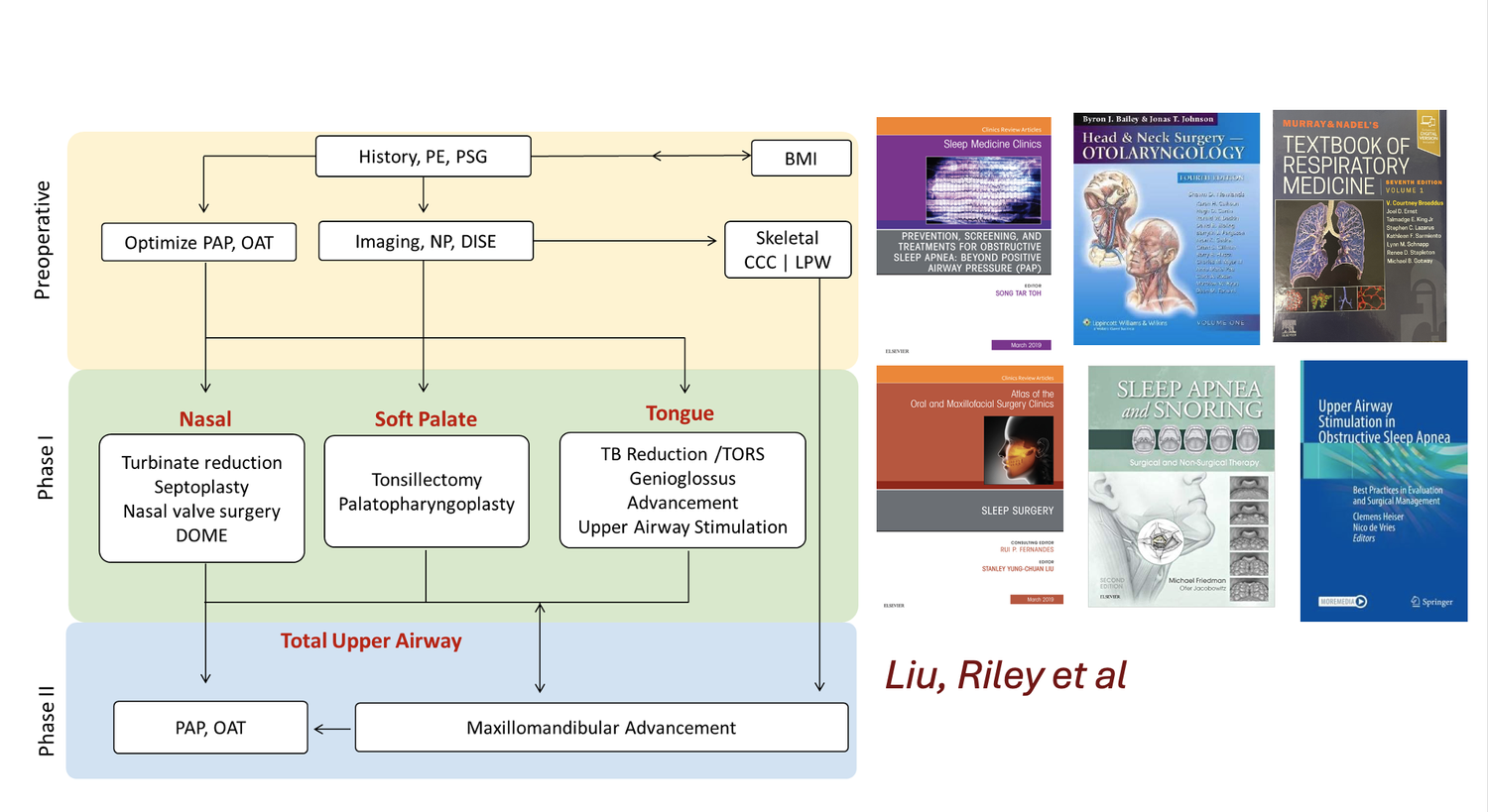
Dr. Liu's chapters on the revised protocol
Start with an evaluation
Every plan begins with understanding your airway. Contact Dr. Liu to schedule a consultation, or start with the common questions.
Explore further: Obstructive sleep apnea · About Dr. Stanley Liu · Publications