Tirzepatide, studied in the SURMOUNT-OSA trials [1], is now approved for OSA in adults with obesity. AD109 is under FDA review [2]. Both were prominent at CHEST and the AAO-HNSF Annual Meeting this month. They are welcome options for patients who cannot use positive airway pressure.
The updated Stanford sleep surgery algorithm, which I developed with Dr. Robert Riley and Dr. Nelson Powell, already treats OSA care as a sequence matched to anatomic phenotype [3-5]. Two Stanford cohorts show why sequence matters. Some patients were excluded from hypoglossal nerve stimulation because of complete concentric collapse. After a modified palatopharyngoplasty, their collapse converted to a favorable pattern [6]. Other patients were initially ineligible for stimulation and had multilevel surgery first, including DOME or maxillomandibular advancement. They achieved a greater adjusted AHI reduction than patients who had stimulation alone [7]. Medication adds a new step to that sequence.
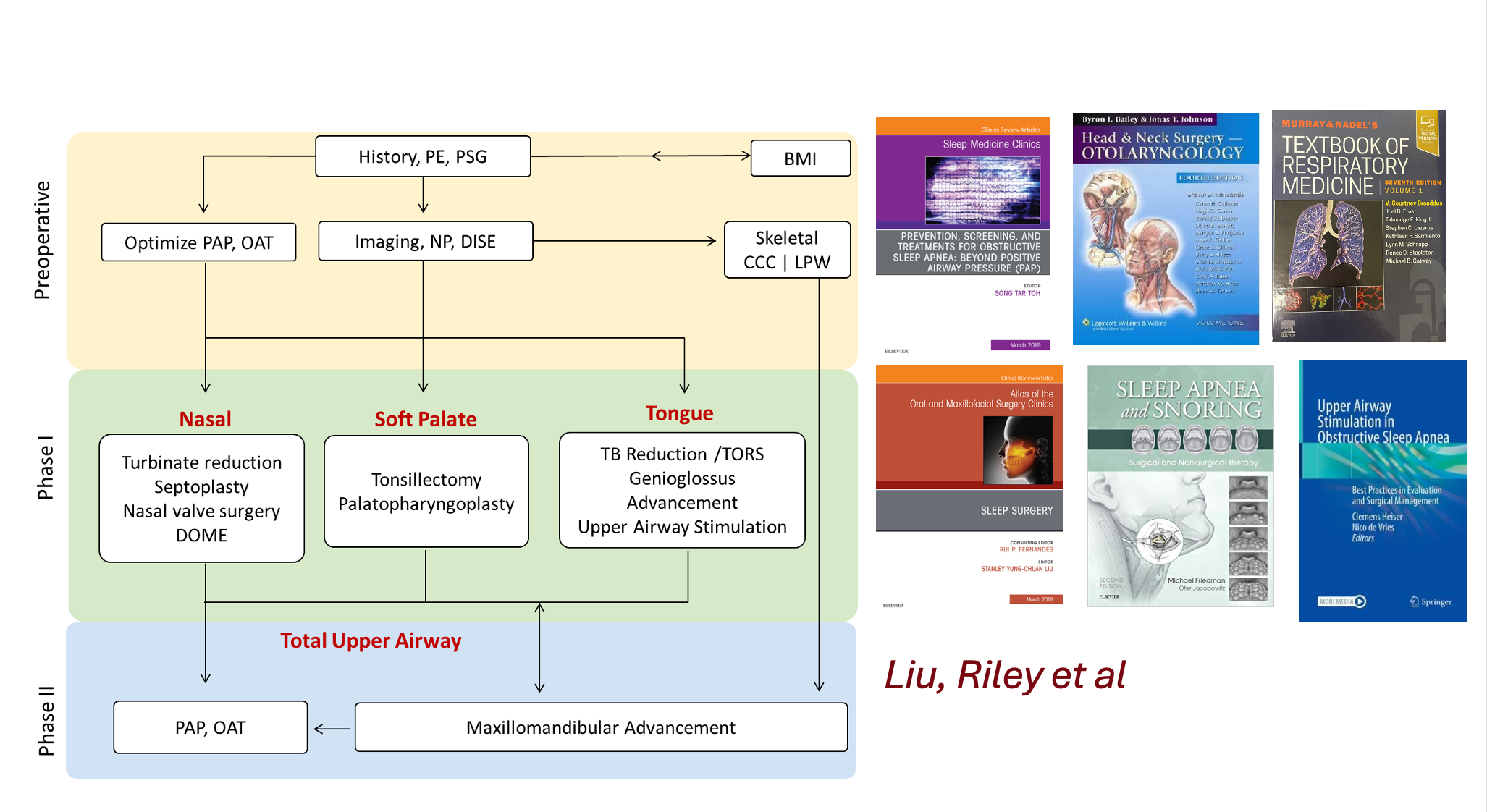
Figure. The updated Stanford sleep surgery algorithm (Liu, Riley et al.), with the textbooks that carry our chapters.
The two drugs act on different traits. Tirzepatide reduces anatomic load through weight loss [1]. AD109 targets pharyngeal dilator control [2]. Earlier work with its precursor, atomoxetine plus oxybutynin, found the best response in patients with a lower AHI and a less collapsible airway [8]. Neither drug changes the craniofacial skeleton. Watanabe, Isono and colleagues showed that obesity and skeletal restriction act together on airway collapsibility [9].
This is relevant to many of the patients I see. In our cluster analysis of 421 Korean adults with OSA, a third were non-obese with a definite skeletal discrepancy [10]. Our DOME patients at Stanford had a mean BMI of 26 [11]. Many patients like these fall outside the tirzepatide label.
The International Consensus Statement on OSA, to which I contributed, lists the selection of PAP alternatives and individualized therapy among the main gaps in current evidence [12]. So, a question for colleagues. A patient has moderate OSA and a BMI of 33, with a narrow maxilla, a high mandibular plane angle and a retrusive mandible. Where would you start: medication, skeletal surgery, or both? And in what order?
Sleep physicians, orthodontists and surgeons may answer this differently. I would like to hear how each of you approaches it.
References
Malhotra A, et al. N Engl J Med. 2024;391:1193-1205. doi.org/10.1056/NEJMoa2404881
Strollo PJ, et al. Am J Respir Crit Care Med. 2026;212:1569-1584. doi.org/10.1093/ajrccm/aamag215
Liu SY, Powell NB, Riley RW. Algorithm for multilevel treatment: the Riley, Powell, and Liu Stanford experience. In: Friedman M, Jacobowitz O, eds. Sleep Apnea and Snoring: Surgical and Non-Surgical Therapy. 2nd ed. Elsevier; 2020:104-109.
Liu SY, et al. The role of the revised Stanford protocol in today’s precision medicine. Sleep Med Clin. 2019;14:99-107. doi.org/10.1016/j.jsmc.2018.10.013
Liu SYC, May AM, Mehra R. Sleep-disordered breathing: treatment. In: Broaddus VC, et al., eds. Murray & Nadel’s Textbook of Respiratory Medicine. 7th ed. Elsevier; 2022:1687-1702.
Liu SY, et al. Laryngoscope. 2020;130:E958-E962. doi.org/10.1002/lary.28595
Chang CP, et al. J Oral Maxillofac Surg. 2023;81:557-565. doi.org/10.1016/j.joms.2022.11.015
Taranto-Montemurro L, et al. Chest. 2020;157:1626-1636. doi.org/10.1016/j.chest.2020.01.012
Watanabe T, et al. Am J Respir Crit Care Med. 2002;165:260-265. doi.org/10.1164/ajrccm.165.2.2009032
Kim SJ, et al. Sleep Breath. 2021;25:85-94. doi.org/10.1007/s11325-020-02062-9
Yoon A, et al. Sleep Breath. 2023;27:1967-1975. doi.org/10.1007/s11325-022-02761-5
Chang JL, et al. Int Forum Allergy Rhinol. 2023;13:1061-1482. doi.org/10.1002/alr.23079


